Wednesday, August 03, 2005


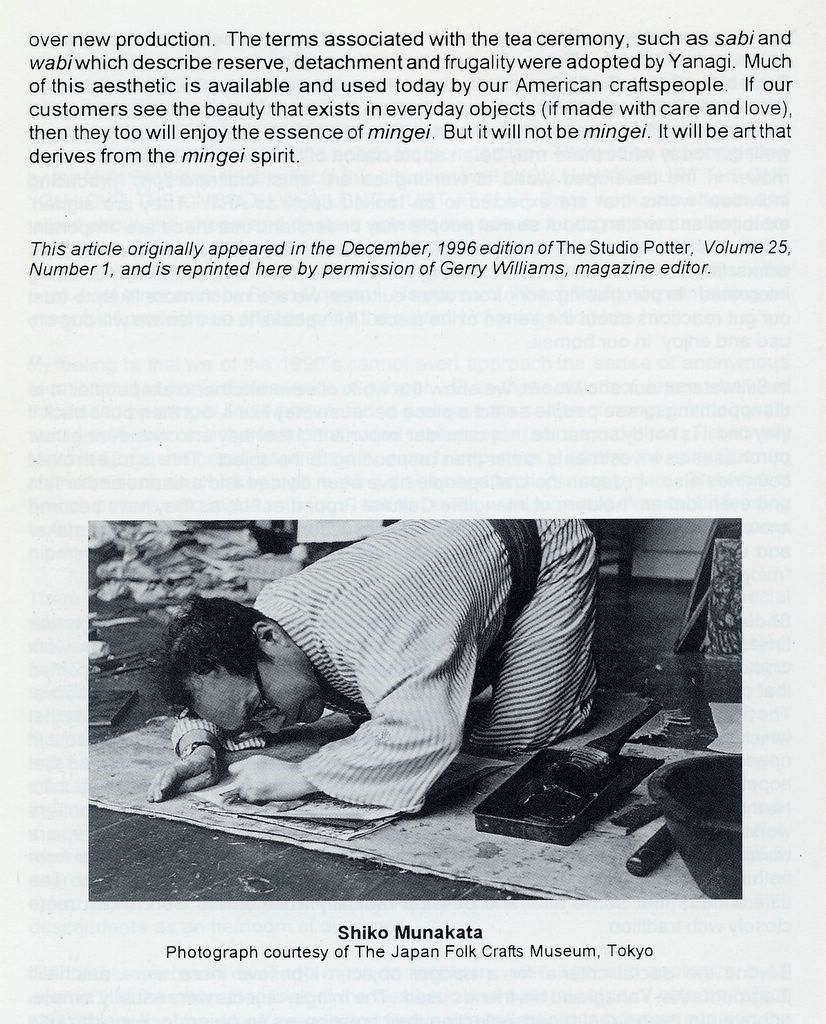
Shiko Munakata. I think he was the greatest genius of the original Mingei group.
Want to post comments? Write me: Togeika@gmail.com

Wednesday, July 13, 2005


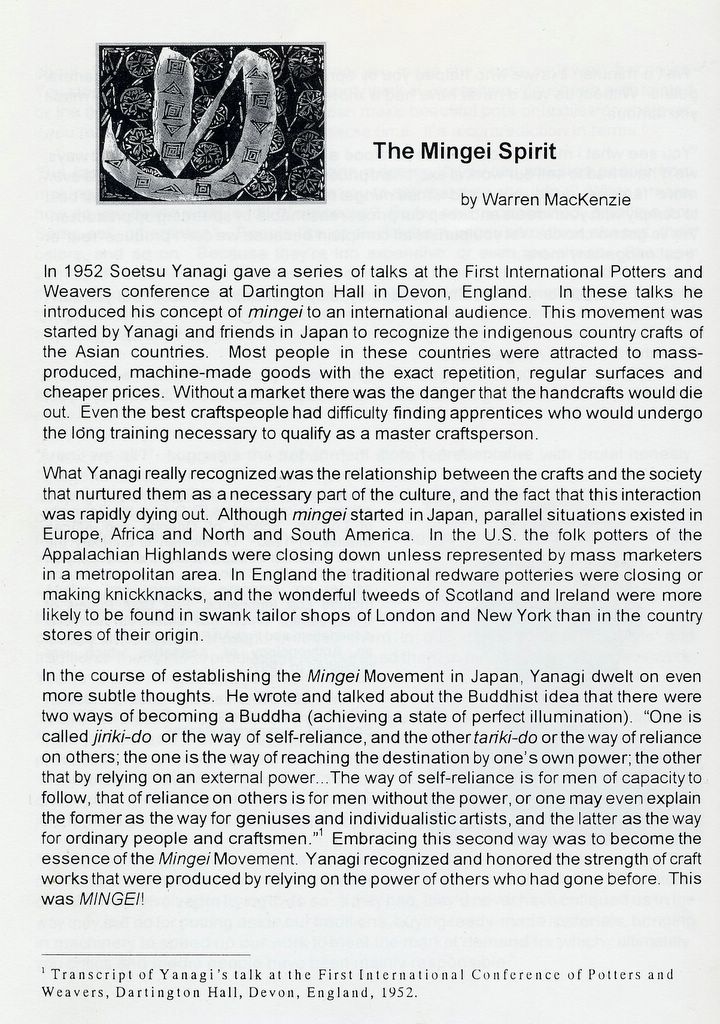
The Mingei Spirit, By Warren MacKenzie
Want to post comments? Write me: Togeika@gmail.com

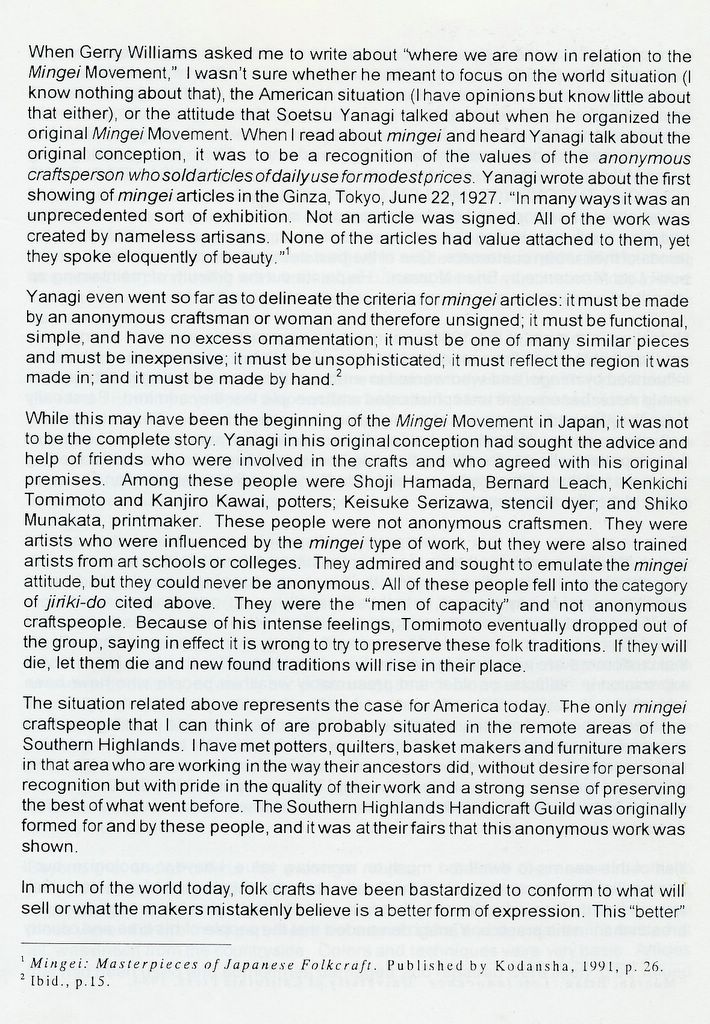
Page 2
Want to post comments? Write me: Togeika@gmail.com

Page 3
Want to post comments? Write me: Togeika@gmail.com

Page 4
Want to post comments? Write me: Togeika@gmail.com

Page 5
Want to post comments? Write me: Togeika@gmail.com

Tuesday, July 12, 2005


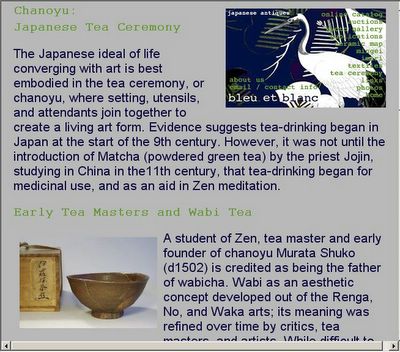
In time the popularity of Wabi style tea increased, and Wabi was further developed by Sen no Rikkyu (1522-91), who would become the most legendary tea master. Rikkyu's tea ceremony is remembered in part for his introduction of koraimono (Korean objects, which he purported held qualities markedly different from those of Japanese and Chinese arts) and in his promotion of the new pottery known as Raku, which would eventually become the preferred pottery form for tea bowls, or chawan.
Want to post comments? Write me: Togeika@gmail.com

Wednesday, July 06, 2005


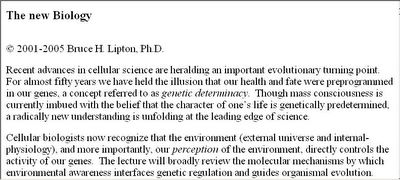
I heard an interesting program on KQED today. The makers of the movie: Mana, Beyond belief and also the author of The Biology of Belief. Both of these seem to parallel a non-mechanistic/non-materialist approach to creativity.
Want to post comments? Write me: Togeika@gmail.com

Francis Bacon defined the mission of modern science shortly after the onset of the scientific revolution (1543).? Accordingly, the purpose of science was "to dominate and control Nature."? To accomplish that goal, scientists had to first acquire knowledge of what "controls" an organism?s structure and function (behavior).? Concepts founded in the principles of Newtonian physics defined the experimental approach to this quest.? These principles stipulate that the Universe is a "physical mechanism" comprised of parts (matter), there is no attention given to the invisible "energy."? In this world view, all that matters is "matter."? Consequently, modern science is preoccupied with materialism.
Want to post comments? Write me: Togeika@gmail.com

Tuesday, May 17, 2005


BILL MOYERS: "The story I've come to share with you goes to the core of our belief that the quality of democracy and the quality of journalism are deeply entwined. I can tell this story because I've been living it. As Dr. Wilson said, it's been in the news this week, including more attacks on a single journalist, yours truly, by the right wing media and their friends at the Corporation for Public Broadcasting. As you know, CPB was established almost forty years ago to set broad policy for public broadcasting and to be a firewall between political influence and program content. What some on its board are now doing today, led by its chairman, Kenneth Tomlinson, is too important, too disturbing, and yes, even dangerous for a gathering like this not to address it. We're seeing unfold a contemporary example of the age old ambition of power and ideology to squelch -- to punish the journalist who tell the stories that make princes and priests uncomfortable." BILL MOYERS
Lee Love

Monday, May 16, 2005


Interesting overview of Zen. I especially liked the encapsulation of Dogen's thought in the nine points below:

These are nine points that can be extracted from Dogen's thought:

1. Identity of self and others. Zazen is the complete realization of self, identifying with others. He said: "To study the Way is to study the self. To study the self is to forget the self. To forget the self is to be enlightened by all things. To be enlightened by all things is to remove the barriers between one's self and others.?"

2. Identity of practice and enlightenment. There is no difference between practice and enlightenment. There should not be any attachment to the outcome of the practice.

3. Identity of the precepts and Zen Buddhism. Novice monks must know the 16 Bodhisattvas precepts before becoming monks. There is no difference between the precepts and Zen itself. When enlightened he is already endowed with the precepts.

4. Identity of life and death. Although most people love life and hate death, nobody can avoid death. Once you come to terms with death, there is no life or death to love or hate. Both are part of the life of a Buddha.

5. Identity of time and being. Time is being and vice versa. Time can only be experienced but cannot be cognized. Now is now which includes past, present and the future. Without now there are no others. Now is absolute and eternal. Once lost it never returns. So practice continuously without delay.

6. Being and nonbeing. Nonbeing is not nothing. It is being and vice versa. In non-dualistic terms, both are absolutes. So we have both the Buddha-nature and we also do not have the Buddha-nature in non-dualistic viewpoint. Nonbeing in Zen is never the nothing of nihilism but it is a lively and creative function of the Way.

7. Men and women. There is no gap between right and wrong, clever and foolish, high and low social status, or men and women. All can realize Buddhahood. The Way is open to men and women equally.

8. Monks and lay people. Both can practice, but monks are free from world affairs. Lay people can pursue the Way but their practice must be intense and persistent. Of course the best is to become monks and follow the precepts. Remember Dogen?'s teaching is that practice takes precedence over theory.

9. Sutras and Zen Buddhism. The Way of the Buddha-mind is beyond letters and sutras, because attachment to the letters and sutras is itself a hindrance. So it is the attachment to the letters and not the letters that must be cast away.


Lee Love
Monday, May 09, 2005


This is one of the last texts I studied with Dainin Katagiri Roshi.
Lee Love

Tuesday, April 19, 2005


"I seem most instinctively to believe in the human value of creative writing, whether in the form of verse or fiction, as a mode of truth-telling, self-expression and homage to the twin miracles of creation and consciousness. " --John Updike, essay for the "This I Believe" Project.
Lee Love

Thursday, April 14, 2005


Dr. Martin Luther King Jr. http://www.stanford.edu/group/King/publications/speeches/Beyond_Vietnam.pdf
Lee Love

Sunday, April 03, 2005

Wednesday, March 30, 2005

Saturday, March 26, 2005

Ryokan's Precepts of Right Speech

Take care not to:

talk too much
talk too fast
talk without being asked to
talk gratuitiously
talk with your hands
talk about worldly affairs
talk back rudely
argue
smile condescendingly at others' words
use elegant expressions
boast
avoid speaking directly
speak with a knowing air
jump from topic to topic
use fancy words
speak of past events that cannot be changed
speak like a pedant
avoid direct questions
speak ill of others
speak grandly of enlightenment
carry on while drunk
speak in an obnoxious manner
yell at children
make up fantastic stories
speak while angry
name-drop
ignore the people to whom you are speaking
speak sanctimoniously of gods and buddhas
use sugary speech
use flattering speech
speak of things of which you have no knowledge
monopolize conversations
talk about others behind their backs
speak with conceit
bad-mouth others
chant prayers ostentatiously
complain about the amount of alms
give long-winded sermons
speak affectedly like a tea master

—Ryokan (1758-1831)


"RyƓkan declared there were three things he disliked:
poet's poetry,
calligrapher's calligraphy,
chef's cooking."

Monday, March 14, 2005


Freedom is just another word for nothing left to lose,
Nothing don't mean nothing honey if it ain't free, now now.
And feeling good was easy, Lord, when he sang the blues,
You know feeling good was good enough for me,
Good enough for me and my Bobby McGee.
Janis Joplin on Shunyata. Click on lyrics for full song lyrics
copyright 2005 Lee Love

Sunday, March 13, 2005


We Are all Made Of Star Stuff. Check out the images at the Chandra X-Ray Telescope!
copyright 2005 Lee Love